If Emerald Ash Borer has been confirmed in your area, as is the case with St. Louis and St. Charles Counties, your first step is to decide whether or not your tree is worth treating to prevent infestation. I will put together a post on what goes into this decision in the near future. Today, let’s assume that you have determined (with expert advice, I hope) that your tree is too valuable to you to remove and you would like to have it treated. Here are 5 important facts to consider, regarding the treatment of Emerald Ash Borer:
-
There are options available for do-it-yourself, homeowner treatment.
Imidacloprid is the most common insecticide available to homeowners. It is typically applied as a soil drench. Be sure to read up on regulations that specify how much Imidacloprid can be applied over the course of the year. These treatments are an option for those who want to make a minimal financial investment. However, it should be noted that Ohio State University and Michigan State University trails have shown that Imidacloprid soil drenches give inconsistent results.
-
All hope is NOT lost! There are effective, preventative treatments.
The most common treatment a professional will use is emamectin benzoate (TREE-äge™). This treatment is performed by trunk injections, starting in May or June. Studies in both Michigan and Ohio have shown that even at a low application rate, injections of emamectin benzoate have proven to be greater than 99% effective.
-
Treatment is typically less expensive than removal.
A single emamectin benzoate treatment provides consistent protection from EAB for a period of 2 years. Removal costs, particularly in larger trees, are typically much higher than treatment costs. This does not take into account the benefits of keeping a healthy Ash tree with several years of useful life (property value, shade, erosion control, etc.)
-
If your tree is showing 50% or more canopy decline (thinning or die-back), it is too late.
Waiting until your tree is infested is not a great option for most homeowners. A proactive approach is vital, especially if EAB has been identified within 15 miles of your home. Emerald Ash Borer can be present in a tree long before symptoms begin to appear. Oftentimes, when a homeowner notices that there is a problem, it is too late.
-
If you live in Missouri, you are under quarantine!
Emerald Ash Borer is here. It is everyone’s job to try to prevent it’s spread. The USDA has placed a quarantine on infested areas and there are fines in place to prevent potentially infested ash trees, logs or hardwood firewood from moving out of areas where EAB occurs. Visit http://www.emeraldashborer.info/ for more information.
That’s all, for now! Thank you for stopping by.
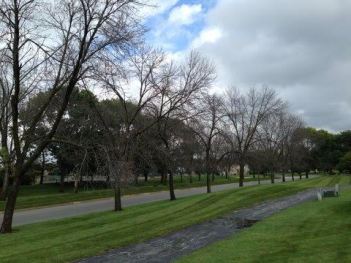
Don’t let this be your neighborhood:
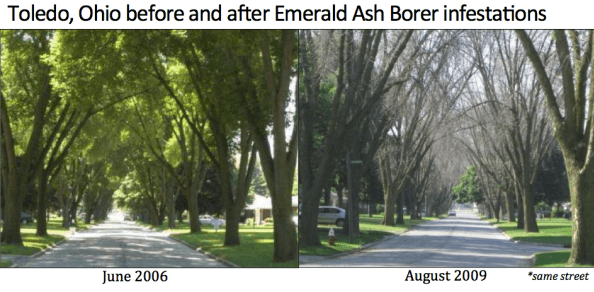
 pulations of many cities. This pest has been found in St. Louis and, if you have an Ash tree, you WILL be impacted. You may remember the
  sebastian the arborist